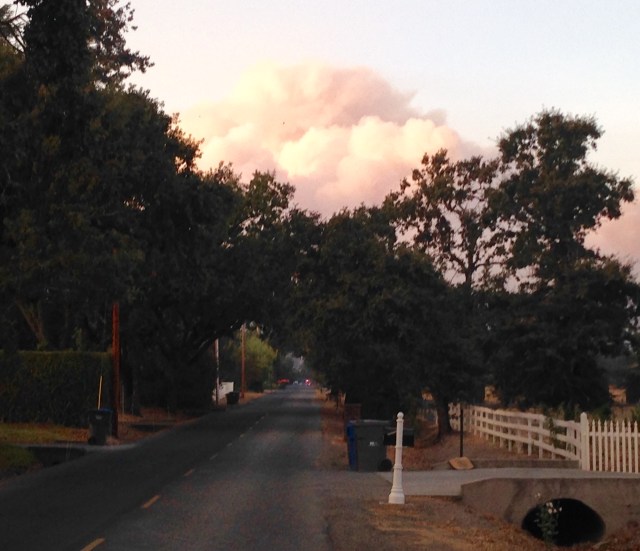
Fire
During our second fall in Sonoma some thirty years ago a wicked wind kicked in one night, blowing from northeast to southwest, rousing me from sleep. I pulled on a pair of jeans and stepped out the front door to experience the torrent of air, wondering as I ambled across the lawn how the sky could be so spangled with stars. No storm. No rain. Just wind. I blundered into the neighbor’s 60-foot pine tree, blown down across our yard. In the following days insurance adjusters with checkbooks issued payments for smushed cars, busted roofs, shattered glass, and our gutter which the toppled tree peeled off the eave.
My first experience of Diablo Winds.
The meteorologists explained the phenomenon. Simultaneously a high pressure system settled to the north while a low pressure system stationed to the south. The movement of air from big millibars to little millibars generated enough velocity to uproot trees, none of which, miraculously, cast sparks from a downed power line. Those Diablo Winds returned to the Wine Country on the night of Sunday/Monday October 8/9. No one yet knows what kindled our fires, but downed or arc-ing power lines are likely culprits.
We enjoyed record-setting rains last winter which prompted abundant growth of understory in the Mayacamas Mountains separating Napa Valley from Sonoma Valley. Then, last summer, record heat parched that massive shrubby growth and the trees above it, trees already compromised by California’s five-year drought. Square miles of fuel.
The Diablo Winds act like water. They hug the ground and gather strength and concentration in valleys aligned with them, sheeting and converging like rivers plunging downstream. Add sparks to the mixture and you get flames behaving like fire hoses, nozzling fire in narrow channels of destruction. One of the northeast/southwest valleys through the Mayacamas Mountains channeled fire from Calistoga to Santa Rosa like a flame thrower, arriving in the Fountaingrove and Coffey Park neighborhoods as out of nowhere. When the voracious flaming winds encountered buildings, they eddied. As the homes and landscaping and automobiles and propane tanks exploded in flame, the superheated air rose in skyward fingers and sucked in cooler oxygen-laden air from all points of the compass. The wind eddies turned the firestorm into accelerating twisters. Imagine flaming tornados ripping through a Kansas town. The fiery cyclones flipped cars, felled trees, and ripped away garage doors to wrap them around utility poles. Slumbering inhabitants of these precincts wakened to a hideous roar outside their glowing windows and dashed for their cars in a maelstrom of high velocity embers. In the ensuing scramble not everyone escaped.
Another flame nozzle blasted over the southern expression of the Mayacamas into the eastern edge of Sonoma Valley, scant miles from my home. Friend Ramona saw the flames on the ridgetop above her home racing down on her like a freight train. She threw her dogs into the car and watched the inferno reach the structures in the rear view mirror. When I drove up her driveway on Monday morning I found her teenage daughter, Natalie, straggling along in search of her cat, which had escaped the inferno but was sheltering, somewhere. She cried on my shoulder then walked me to the smoldering ruins of the house where she grew up. In the immediate environs of the town of Sonoma, Ramona’s home was one of perhaps a dozen to burn. But as you trace the Valley of the Moon northwards from Sonoma town through Glen Ellen and Kenwood to Santa Rosa, the number of destroyed houses rises past five thousand, and the number of deaths rises past forty, with some still unaccounted for.
Our friends Randy and Linda built their home by hand over decades on a wooded hillside up Cavedale Road, north of town. When our congregation assembled for hugs and donuts and storytelling on the Sunday after the fire, they walked in and shared their resolve to rebuild. When the time comes we will drive up there with chain saws and tool belts to help them, but it will not be easy. First they will have to saw and drag charred trunks from their snaking steep driveway. Even to haul away the scorched debris, they will need to get a toxic disposal permit. Then a building permit, insurance payouts, loans, and the human will to make back a home where nothing now stands. They are one family among thousands who will be looking for contractors and carpenters and electricians and plumbers and financing in the many months to come.
In all I know three families who lost their homes, and two who experienced near misses. I reached one of those near misses on Tuesday morning, up a twisty road above Sonoma’s Plaza. When I got there I found two red fire trucks in the smoky yard whose crews minded grass fires nearby between fitful naps. I called Pat and Sam on my cell to tell them their house was standing. Pat answered and wept at the news.
Buck and Mary survived another near miss along Thornsberry Road where the fire commander pulled his crew when spot fires erupted in the brush along their cul-de-sac that twists along among ample combustibles. It happened that his crew of firefighters from San Diego included one stalwart who had spent his youth on that very road, and who then defied the orders of his superior. He and a pal decided to stay put and to scramble from yard to yard in his old neighborhood, swatting down blazes, heaving deck furniture into swimming pools, sawing down bushes and trees near structures, and dodging the flames. When the officials allowed Thornsberry Road residents back in, days later, they gathered for a neighborhood celebration, and included the two men who had preserved their homes so that they could thank them and hug them and give them heartfelt smooches.
When you live in fire country, you defend your home. You mow the dry grass down to the dirt. You clear the leaves from the roof. You turn on the sprinklers when an actual fire threatens and unreel the hoses in case a blazing brand falls out of the sky. Even so, I crammed the car with the sacred crud in case the Diablo Winds pointed a firestorm in our direction.
The car stayed in the carport because we are far enough south in the valley that the Mayacamas fires failed to threaten. Many others, thousands of others, decamped for couch surfing in distant towns and counties. Some returned home soon, as the Pacific Gas & Electric crews restrung wires and repaired exploded transformer boxes. Many thousands of others have nothing to return to, and will have to decide, one family by one family, just what to do about the rubble piles that used to be their houses. What will their insurance company pay, if they have one? What will FEMA provide? How long will it take to scrape away the remains of an old house, to build and furnish a new one? Where will they live in the meantime? Should they convert their insurance payout into a new place altogether, one without the shattered memories?
In the Northern California Wine Country, vineyard maintenance, grape harvesting, vine pruning, and soil tilling rely on many thousands of Mexican laborers, some of whom have been here long enough to obtain green cards and the associated measures of stability and security. Others lack documentation yet earn their daily bread and pay their taxes to Uncle Sam never knowing when a traffic ticket or an ICE sweep may net them into detention and deportation. Some of these neighbors have managed to purchase homes; many send their children to our schools and colleges. For all of these undocumented people on whom the Wine Country’s primary industry — wine — absolutely depends, the pre-existing measure of insecurity has been magnified by the fires. They are ineligible for FEMA assistance. The wineries which employ them are stricken by the sudden crash of tourism. Though all but a small percentage of late-harvest Cabernet grapes had been harvested before the fires, and though few wineries were cordoned off-limits by CalFire officials until electricity was restored and roads were cleared, the perception out there seems to be that the Wine Country is not now a favorable destination for oenophiles the world around. Who wants to visit scorched earth, even though scorched earth is virtually nonexistent in the renowned growing regions of Napa, Sonoma, and Carneros? The scorched earth is up in the hills and in those concentrated neighborhoods where topography and wind combined with deadly narrow effect. But perception rules, and perception suggests, Honey, let’s go to Hawaii or Disneyland this year while they clean up the mess.
So the economic engine in these parts gasps for fuel just now, and the laborers at the bottom of the Wine Country financial pyramid suffer most acutely, and those without documentation most acutely of all.
We count ourselves lucky here in the Wine Country. We share the same general latitude with Provence, Tuscany, and the Northern Sporades Islands of Greece, and with them the Mediterranean climate that favors grape growing and olive cultivation. In the fall our vineyards shout the russets, yellows, and reds of hardwood New England. In the winter frost visits on the occasional night. Spring brings explosive growth of the vines and mild days. Come summer and we watch the grapes fatten under cloudless azure skies. We are not Bali or Kauai, yet visitors flock here from the world around to taste our agricultural produce, to stroll our historic plaza in the center of town where we assemble on summer Tuesday evenings for the farmer’s market and music, and to book rooms and tables at this valley’s resorts and restaurants. They clot our intersections with their careless crossings but we love them nonetheless because they cover our collective nut with their expenditures.
We are a tourist destination groping to balance the cash infused by visitors with the needs and wants of townspeople who shop here, marry here, worship here, and pray that our children can return from college to find affordable living down the road. Alongside us many Maria’s and Jose’s see our paradise as a place of grueling labor under the scalding sun and as a toehold on the climb towards something better for their kids than life in Jalisco and Michoacan. We are all hurting now, and these uncomplaining undocumented laborers most of all.
Contributions pour in from individuals, churches, nonprofits, and corporations near and far. A week after the deadly first night of catastrophe, refugee centers sent out the word: No more in-kind contributions of food and clothing. We are beyond capacity. Our refrigerators are bursting. What we now need is cash . . . for rent payments, groceries, gas. Those many who live from paycheck to paycheck wonder how they can make it when the paychecks evaporate.
Our across-the-street friend Sarah invited in the neighborhood ten days on for chow and stories. The next night my congregation assembled in the fellowship hall for more of the same. My communities are intact and functioning. But how about the community of Coffey Park whose physical manifestation is gone and whose human manifestation has scattered? Their physical losses are total, but are those losses of photos and carpets and treasured furniture inherited from Grammy worse than their loss of human community? Without crawling into their hearts how can one begin to answer that?
Houston. Florida. Unspeakable Las Vegas. Puerto Rico. The Wine Country. Suffering and loss. Beyond that, we read in the newspapers of even more incalculable suffering among the Rohinga people of Myanmar. What to make of all this? I cling to gratitude. People show up with all their talents and good intent. Fire fighters and cops and helicopter pilots sail into the flames to save people, and as many homes as those that burned. Civilians return to burning buildings to haul out their elders and their friends. Then someone shows up in the morning light with a water bottle and a sandwich. For weeks, outgoing long-distance calls were frustrated by recorded messages advising that All circuits are busy. Yes, busy with friends in all time zones calling to ask: Are you OK? and to assert: I love you! Good will abounds among the ashes.
Signs and posters have sprouted all over town. First Responders, Fire Fighters, Pilots, Heroes: THANK YOU.


 hutch adventure 2
Thank you, Bill, your words remind us to hold close those we love, near and far. We are grateful for our good fortune in health and happiness and keep all of the people whose lives have been forever changed in our prayers. We will continue to contribute where we can. We will celebrate this season with awake hearts. Xoxo, Julie and Steve
LikeLike
Hugs to you this Thanksgiving Bill. Best to
all!
Cadie et all
LikeLike
Hello Bill.
Man do I wish I could write like you.
You were lucky and so are we.
HAPPY THANKSGIVING!!
Jean, Helene, Daniel, Hanne and in a few days Aksel.
LikeLike
Happy Thanksgiving Bill. We are so blessed to hear from you – my heart goes out to you and those you encounter in your world. Your blog makes it feel real… what those people are going through.. wow. 6000 homes lost… schools lost ..
We are blessed to be ok…
love to you
Jim and Niz
LikeLiked by 1 person
PQue linda foto.
Gracias Bill
Mirna
LikeLike
What a beautifully written blog on the fire. You really captured the many
emotional aspects that continue to run through the community…so many
types of losses that will linger for days, months and years. The healing
has started and gaining strength person by person. Extending helping
hands…holding hands.
I’m sure that you know that you know this is still coming from you and
Lori. Technology is so confusing!!
I hope you have a wonderful day with your beautiful family.
xox
Jane
LikeLike
Dear Bill,
I don’t think I’ve ever read something you wrote where I didn’t wish I’d been able to do as well.
Where’s the book???
Happy Thanksgiving
xxoo ME
LikeLike
You are an insightful and gifted writer. All you need is an agent!!! Happy Thanksgiving – as it certainly is for you. Herbert
LikeLike
Wow, thanks!! Have sent in to Louisville friends whi had planned a trip there, had to cancel because of the fire. Are you sending this to NYT/opinion people? Please do.
LikeLike
You nailed it, Bill. I intend to pass your narrative to friends and family. Norm
LikeLike
what he says
I wish I wrote it
xxoo ME
LikeLike
Wonderful Bill, just wonderful!!!!! Hugs, Kathy
LikeLike
Hi Bill, Glad you and your house survived. Judith
LikeLike
Thank you, Bill! You have such a wonderful gift for writing down your thoughts – this is something I will keep, to re-read often and be inspired!
Love you,
Judy
LikeLike
Beautifully written and so accurate,
as always. This will make a great op ed for any newspaper. Peace and good fortune.
LikeLike
Maybe submit this to the Index Tribune, and/or Press Democrat? That way, more people could be/would be grateful for the hope and reassurance you convey in your blogs….
LikeLike
Bill is an excellent writer–and speaker!!! I wish I had his writing talent. It’s time he wrote another book. Helen
LikeLike
Thank you for sharing your story Bill. 🍁
LikeLike
Thank you Bill to share with us this very special moment. We were with you in thought when we saw it at TV
Love from south Africa, We have a fantastic time here.
Bises
Colette & Andi
LikeLike
Thank you Bill. This was beautifully done. I have shared it with others
LikeLike
Beautiful writing, Bill! You have such a gift. Thank you for this uplifting piece that is both informative and healing. Hugs, Margie Mitchell
LikeLike
Willy,
Reading your blogs is like having a literary Ted Talk. Just love them. Mother would be so proud!
Love ya,
Sister Anne
LikeLike
Thanks for sharing your poignant narrative as we remember the fires, responders, and our affected neighbors during this season of gratitude and hope.
Take good care,
Nita Lott
LikeLike
Bill, just wanted to let you know how great your blog on the fire was.
Warm regards
Holly
LikeLike
Thanks for putting into words both the horror and the beauty of the wildfires. I was the Red Cross shelter manager at the Veterans Memorial in Santa Rosa for eleven unforgettable days. Ann served as a nurse. I listened to heartrending and heartwarming stories told by the shelter residents, many of whom had barely made it out with only their pajamas and slippers. One of the most beautiful things I have ever seen was the way people who had just lost everything, who were in agonizing grief, found the strength to help others in the shelter. The Vets Memorial became the shelter for those with serious medical needs – 60 patients from Kaiser Hospital, patients from nursing homes, drug treatment centers, home care frail elderly and patients under Hospice care. Together, – Kaiser docs and nurses, Red Cross volunteers, local folks who wanted to help, Salvation Army, shelter residents – we formed an amazing caring community, an experience I will never forget. Sometimes, it takes the worst to bring out the best.
Shalom, Bill
LikeLike