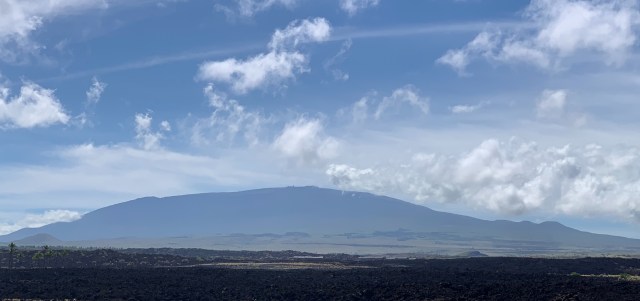
Mauna Kea
Lava
Pop quiz.
Quick . . . what is the tallest mountain on earth?
Mount Everest, right?
Sorry, gamers. Mount Everest is the highest mountain on earth, measured in elevation above sea level, at 29,035 feet. The tallest mountain on earth, measured from base to summit, is Mauna Kea, the central volcano on the Big Island of Hawaii where the astronomers have planted a forest of telescopes. The base of Mauna Kea is the floor of the Pacific Ocean, 19,700 feet beneath the waves. Mauna Kea looms 13,796 feet above the waves for a total loft of 33,500 feet, nearly a mile taller than Everest. Try climbing that!
By the way, on this tallness scale Everest ain’t even the tallest continental mountain. From base to peak, Mount Kilimanjaro is a thousand feet taller than Everest is from bottom to top . . . 18,372 feet to 17,060 feet.
(Parenthetical insert. Nephew David Hartman — an otherwise sane and balanced son, brother, husband, father, nephew, and police officer — plans to stroll up Kilimanjaro next year with some other do-gooder pals to raise money for the Special Olympics. That’s right, Kilimanjaro, where annually ambitious trekkers die from acute altitude sickness and unintended plunges from trail edges. Feel free to send me a massive check which I will promptly forward to David with an invitation to climb Mount Tamalpais instead).
OK where was I? Right. Lava.
It staggers the imagination to contemplate the number of volcanic lava flows it has taken to accrete the island of Hawaii, six miles and change from the basement of the Pacific to its present summit. Yeah sure, everywhere you look on Hawaii you see old lava flows frozen in place like rivers of, well, rock. Each of which incinerated vegetation, buried ill-advised housing developments, and laminated a gozillion layers of frozen lava right down to the bottom.
On the southern protuberance of the Big Island, Kilauea Volcano has been continuously active since 1983, geysering fountains of liquid rock into the sky while expelling rivers of molten lava across the landscape and into the sea. Talk about steam! Madam Pele added fifty acres of state-owned land to Hawaii over the past four decades but decided to take a nap a year ago thus denying Jane and me item 7 on our bucket list . . . molten lava.
Dang.
The volcanologists predict that Kilauea will snooze for a decade or so, so that item may go unchecked.
Double dang.
Instead we tromped around over ancient lava flows and recent lava flows . . . and marveled. The Hawaiians have two words for settled lava: a’a and pahoihoi. Most of it in these parts is a’a (pronounced ah ah) which results when fast-moving lava flows cool and settle. The top of the lava flow congeals first, starts to become solid stone, then is fractured massively by the molten lava flowing below. The result: chunky, sharp-edged fields of basalt prepared to shred your sneakers into tatters. The ancient Hawaiians transited these a’a fields barefoot. If you tried that the medics would recover your body parts with tweezers.
But here’s the thing.
Plants find footholds in a’a fields. Rain falls. Leaves and grass blades accumulate. More rain falls, and . . . slathered over the lavas, grasslands and trees spring forth. On the rainy side of Hawaii rain forests flourish. And then another lava flow torches everything in its path to start the whole cycle anew.
The resorts and golf courses of the Kohala Coast of Hawaii were constructed, every one of them, over heaps of a’a. Here’s how they did it. They imported massive machines to grind the a’a into small bits, spread that pulverized lava over the jumbled a’a flows until ragged heaps became level fields, then spread a skin of topsoil over all. Fairways. Lawns. Palm trees. Plumeria trees. Hotels.
Paradise.
Meanwhile, twenty miles south of the Big Island, the newest volcano (Loihi) rises from the floor of the Pacific. At current rates of growth Loihi will rise above the waves in 100,000 years to form the next Island in the Hawaiian chain. Or maybe not. Maybe Loihi will end up as a sea mount and will cede Island status to the next formation to accrete over the Hawaiian Hot Spot.
We won’t be around to witness Loihi or the one after that. Hawaii is a work in progress. Look closely to see what it was, what it is, what it will be.


 hutch adventure 2
As always, a pleasure to read. xxoo ME
LikeLike
What great information! We’ll be there in November and will look for the a’a in our journeys. Enjoy!
LikeLike
Hello Bill.
I lived and worked in Hawaii for several years. Never knew. Excellent education. Thanks.
Hope you are well.
Jean
LikeLike
Aloha Bill…….and mahalo nui loa for sharing your ongoing travel experiences which I continue to enjoy reading over the past few years!
Your present trip to the Big Island in Hawaii was exceptionally enjoyable to read due to my previous experiences living and working in Hawaii for more than 12 years!
Having married a local gal, we enjoyed our business and personal lifestyles that encompassed 10 years with Sheraton Hotels on Oahu and 2 years with InterContinental Hotels on Maui.
Thanks for the memories and continue to enjoy your tour. Steele
LikeLike
Great Bill, learned stuff I didn’t know! Now remember to include Jane in your next picture.
LikeLike
Hi Bill, I also lived and worked in hawaii for many years and learned something new from your article. The smooth lava is usually spelled pahoehoe. I love both of those words . . . they have an onomatapoeic quality. Great writing as usual my friend. Much aloha, jeremy
LikeLike
Hi Bill and Jane
Great to read you. For europeen Hawaii is always a word = Dream .
we are now in Torçay and the actuality is the D Day, 6 June in Normandie (75 years!)
You will be also very interesting.
Thank you and hope to see you soon Colette and Andi
LikeLike
Love these educational blurbs. And I love you too!
Sister Anne
LikeLike
I love reading these updates Bill!
Glad to hear you and Jane are doing well.
Looking forward to catching up with Tucker over the next few days!
Much love
Dan
LikeLike
Once again, thank you for the geography lesson and for building my vocabulary. Had to look up “accrete”😉. Looking forward to your next trip!
LikeLike